Looking For Deep Brain Reorienting Therapy in Ventura?
Deep Brain Reorienting (DBR) is a somatic trauma processing therapy guided by neuroscience. The therapy focuses on clearing the shock that was stored in deeper parts of the brain during a traumatic event or attachment disruption. Basically, unhealed shock that’s stored in the deep subcortical brain can contribute to many present day psychological and somatic symptoms. Also, DBR Therapy can help to clear out shock and body memories around trauma that may not even be remembered. We provide DBR in person Ventura or online all over California.
How Does Deep Brain Reorienting Work?
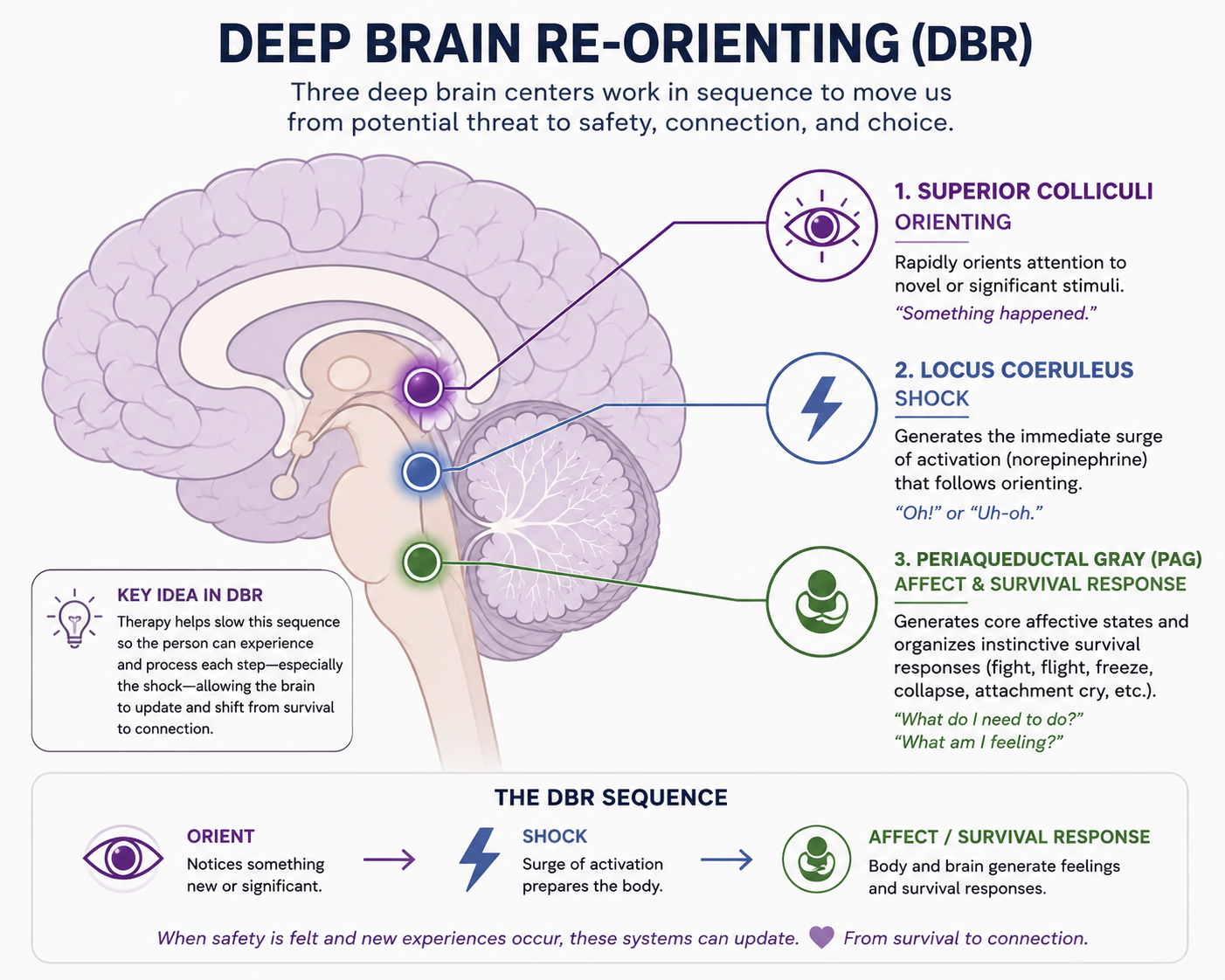
Deep Brain Reorienting was created by Dr. Frank Corrigan a psychiatrist that specializes in trauma. Importantly, DBR therapy is very specific and neuroscience informed. DBR follows a specific sequence that targets the midbrain and brainstem, where trauma or “shock” is believed to be stored. Rather than relying on talk alone, the therapy works through body sensations to access these deeper brain regions.
The three parts of the brain that are targeted are:
Superior Colliculi– the orienting reflex. In a traumatic experience we either orient towards the threat, or away.
Locus Coeruleus– the initiator of shock.
Periaqueductal Gray (PAG)- emotions and defenses.
A study in 2023 showed positive results with people who had PTSD symptoms. A total of eight online sessions which were conducted. In short, at a follow up at three months, 52% of the people in the study no longer met the criteria for PTSD. Another larger study is about to begin.
What Does a Deep Brain Reorienting Session Look Like?
A Deep Brain Reorienting therapy session is truly a different experience compared to traditional therapy. Shock trauma happens so fast, therefore in a DBR session we keep things extremely slow. Additionally, we are focusing mainly on body sensations, looking for and making space for shock energy. After, we clear the shock we then process the emotions related to the trauma.
DBR Sequence
1. Activating Stimulus
First, we decide what we are working on, called the Activating Stimulus. This might be a current day trigger or a traumatic memory from the past. To clarify, a current day trigger might be a panic reaction due to a certain stimuli (sound, smell, something you see). It can also be an involuntary flight, fight, or freeze reaction when a person says something to you in a particular way. Basically, a lot of people with trauma and complex trauma often react to many things in their everyday life due to what the brain learned at an earlier time.
2. Where Self
Then we will continue the very specific sequence that is needed to open the “file” to where the trauma lives in the brain. You will be guided through an exercise called the “Where Self”. Basically, this helps your brain to have awareness of where you are in time and space.
3. Shock Clearing
After this, we continue the process which includes making space for shock sensations in the body. Processing shock can be mild or a bit uncomfortable. Examples of shock: shivers, chills down the spine, shudders, jolts, electric charge, hollowing, pressure in or behind the eyes, pressure in the head, cold or heat, and more.
4. Emotions & New Perspective
Organically, hurt, pain, or emotions might show up that are under the shock. Lastly, we check in for any shifts in experience and shifts in the deep knowings of who you are…a new perspective.
Overall, Deep Brain Reorienting is a slow, quiet therapy that keeps the focus on body sensations. By working through the body, we connect with subcortical parts of the brain, where trauma is believed to be held.
FAQ
What’s the difference between DBR and EMDR?
Both Deep Brain Reorienting (DBR) and EMDR are evidence-informed therapies that can help people heal from trauma, but they work in different ways. EMDR uses bilateral stimulation, such as eye movements or tapping, while processing traumatic memories. Deep Brain Reorienting (DBR) focuses on very early shock responses stored in deeper parts of the brain by working slowly with body sensations before emotions or memories emerge. Some people prefer the slower, body-focused pace of DBR, while others respond well to EMDR. The most appropriate approach depends on your history, symptoms, and therapy goals.
How many DBR sessions will I need?
The number of sessions varies depending on your goals, the complexity of your trauma history, and your nervous system. Some people notice changes after a few sessions, while others benefit from longer-term work.
Can Deep Brain Reorienting help with childhood trauma?
Yes. DBR is often used to address the effects of childhood trauma and attachment wounds by working with the body’s early shock responses that may continue to influence present-day emotions, relationships, and reactions.
Reach Out For DBR in Ventura, California
We are located in Ventura, close to Ojai, Santa Barbara, Oxnard, Camarillo, and Thousand Oaks. In addition we see clients online in Los Angeles County and all over California. Reach out for a complementary 20-minute phone call to discuss working together and to see if Deep Brain Reorienting Therapy is right for you. Call or send me an email to set up an appointment.
Get In Touch
Call
805.669.8176
Location
5550 Telegraph Rd. Ventura, California, 93003
Located near Ojai, Santa Barbara, Oxnard, Camarillo, Thousand Oaks.
Also seeing clients for online therapy all over.